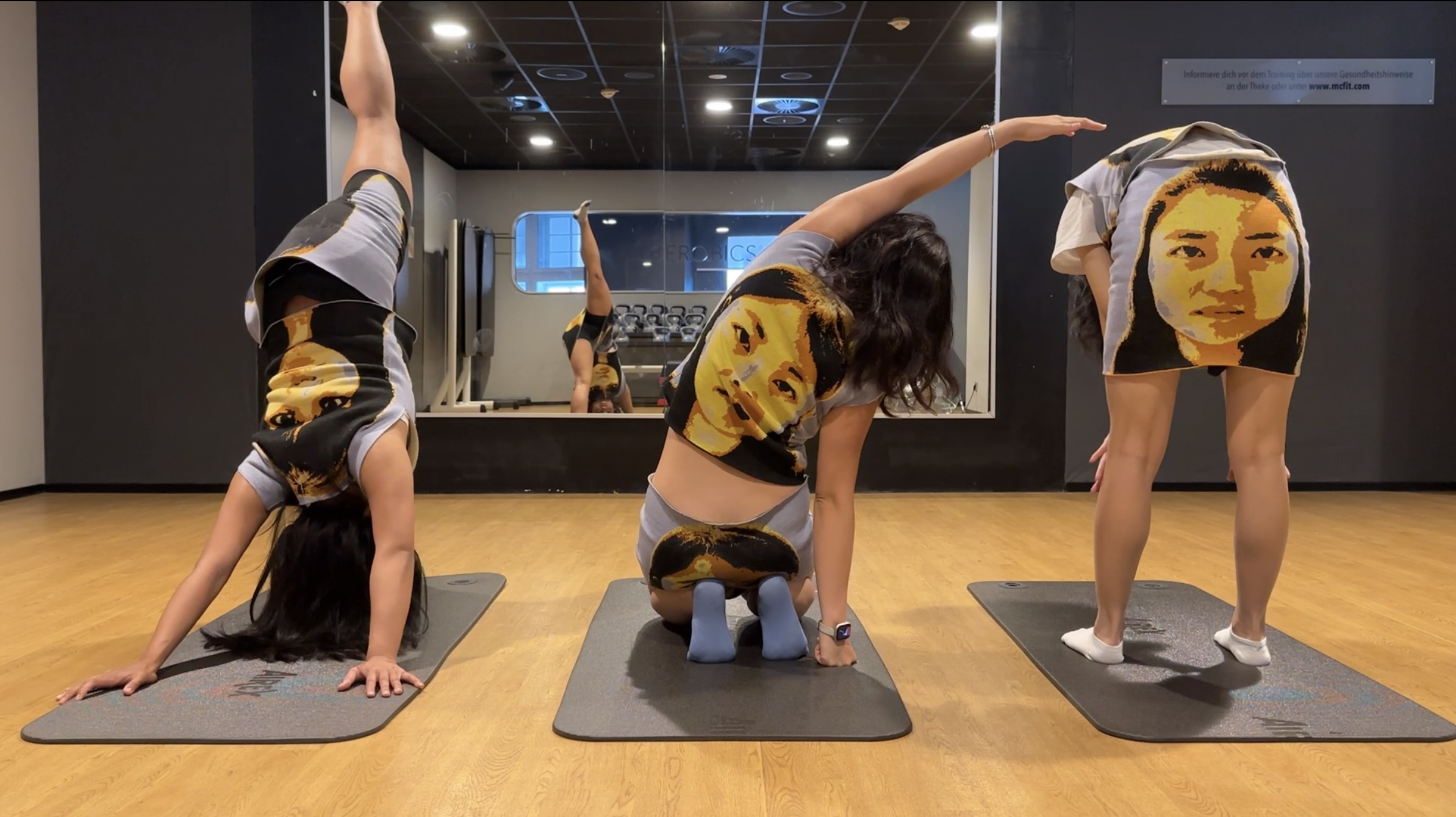
反弹 (Fǎntán)/Watching me watching you is an ongoing collective project by Jamie Yzabel Santos, Yunna Diao, and Ziti Xu. We came together to make this project after relating to each other about similar instances of harassment and fetishization.
“Where are you from?” “How old are you?” “Ching Chong!”
These are just a few racist and sexist catcalls, and sexual advances we hear on a regular basis since coming to study in Europe. The sexualised, submissive image of the Asian woman in men’s minds is so far removed from our own self image and identities. Therefore, we see this project as a way of taking our identities and bodies back for ourselves. We wish to be safe and comfortable in public, without compromising our identities or the self expression of our femininity.
We feel that when men look at us, they only care about the body parts which trigger a physical reaction, so we used knitting machines to weave blouses and skirts with our faces on them. Also, in Europe, we sense that they have very stereotypical impressions of our Asian identity. Even though there are Asians who speak fluent English and German, they cannot escape the stereotypes associated with having an Asian face.
When we showed these photos and videos to some men, they told us it made them very uncomfortable. They said they always look at our body parts first, but when they do, there’s always a face staring back at them, which makes them feel very uneasy.
The word “反弹 (Fǎntán)” comes from a children’s idiom in China. It is directly translated as ‘rebound’. Children will use words to attack each other in games, for example, the opponent will say: I freeze you, I burn you or I stun you. At this point you can say, “反弹 (Fǎntán),” which means to reverse the behavior that the other person is trying to do to you and do it back to them. This seems to us now to be a very sad and idealistic word, where we want to stoically say that the actions of others do not affect us, and reflect back on them. However, when we have been harassed and harmed, “反弹” doesn’t allow us to remove the hurt caused by the harassment.
When we were working on this project, we encountered many difficulties. While we had people supporting us, we also received a lot of opposition. These voices of opposition came not only from men. They believed that men do not harass us solely because of our faces or identity. As Jessa Crispin said in the reviews to How to Suppress Women’s Writing, “I worry that a new generation of readers of this book will often see themselves as the suppressed rather than the suppressor—and if they do, they will not acknowledge their own unconscious biases and the various ways they manifest them.”
Wearing our faces on our bodies is a form of resistance for us, as a way to stare back at the people who perpetuate these harmful stereotypes.
